









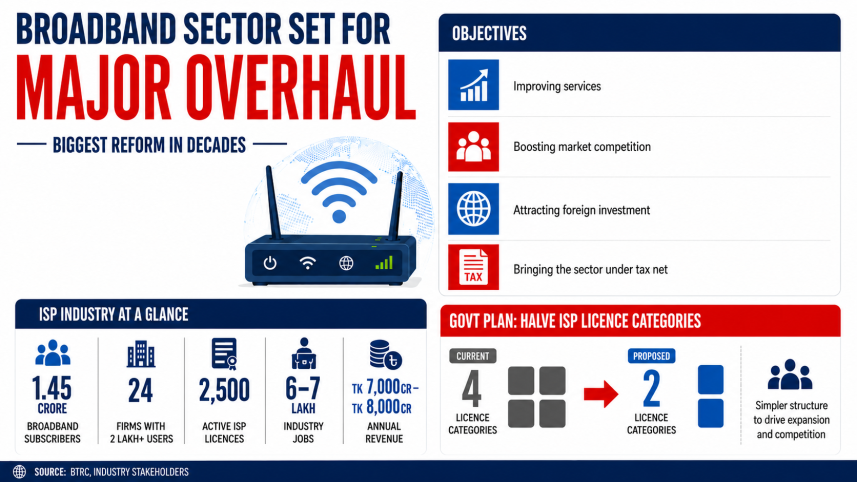
Bangladesh is preparing one of the most significant broadband sector reforms in decades, with plans to simplify ISP licensing, introduce a reseller framework, and attract greater investment into the country’s digital infrastructure ecosystem.
According to officials and industry stakeholders involved in the discussions, the government is reviewing a broad reform package aimed at addressing long-standing issues around fragmented infrastructure, inconsistent service quality, and unregulated market expansion. The proposed changes are being coordinated through the Bangladesh Telecommunication Regulatory Commission (BTRC) and senior government authorities.
One of the biggest proposed reforms involves reducing the number of ISP licensing categories from four tiers to just two: national and district-level licences. Existing divisional and upazila operators would be allowed to migrate into the simplified framework.
Bangladesh currently has around 2,500 licensed ISPs, though officials estimate between 7,000 and 8,000 unlicensed operators remain active nationwide. The government believes the current structure has contributed to infrastructure fragmentation, market disorder, and uneven broadband quality.
The reforms also include a proposed reseller model that would allow smaller operators to legally provide broadband services under larger licensed ISPs without requiring full ISP licences themselves. Regulators argue this could improve oversight and formalize large portions of the grey market currently operating outside regulation.
However, industry leaders have raised concerns that the reseller approach could create pricing instability, weaken service quality, and allow politically connected operators to dominate local markets at the expense of compliant ISPs.
Bangladesh’s broadband market has expanded rapidly in recent years, particularly following the Covid-19 pandemic, which dramatically accelerated internet adoption for remote work, education, entertainment, and digital commerce. Industry estimates suggest the sector now supports up to 700,000 jobs and generates annual revenues of Tk 7,000 crore to Tk 8,000 crore.
The government’s broader ambition includes dramatically improving broadband quality and eventually supporting speeds of up to 1 Gbps as part of its long-term digital infrastructure modernization strategy.
Editor’s Note
This is not just a telecom reform. It reflects the formalization of a rapidly scaled digital economy.
The real story is market restructuring. Bangladesh’s broadband sector expanded faster than its regulatory architecture could evolve.
The opportunity is infrastructure modernization. Simplifying licensing and improving oversight could strengthen broadband quality, investment, and scalability.
The advantage is demand momentum. Bangladesh already has massive internet consumption growth driven by digital services and mobile-first behavior.
The challenge is balancing regulation with market stability. Overhauls of this scale can disrupt existing operators and local ecosystems.
The risk is fragmentation through weak execution. Poorly managed reseller frameworks can create inconsistent quality and accountability gaps.
What to watch next is implementation discipline. The real signal will be whether reforms improve service quality, infrastructure consolidation, and long-term investment without destabilizing the broadband ecosystem.