









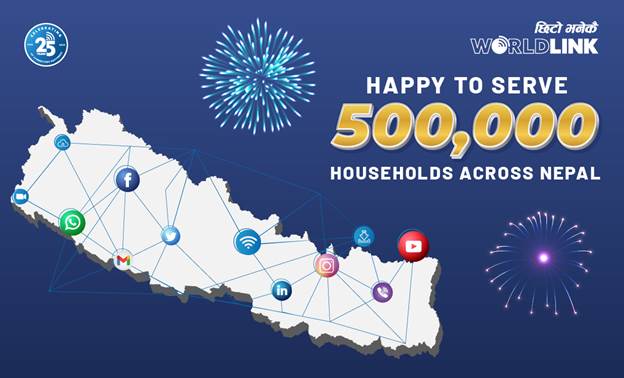
Nepalese internet service provider WorldLink has crossed the milestone of connecting more than half a million households, highlighting the rapid growth of broadband adoption and digital connectivity across Nepal.
The achievement reflects increasing demand for reliable internet services driven by remote work, online education, digital entertainment, e-commerce, and rising digital service usage throughout the country.
WorldLink has become one of Nepal’s most prominent broadband providers through aggressive infrastructure expansion and continued investment in fiber connectivity, including in areas traditionally underserved by high-speed internet services.
The milestone also signals broader maturity within Nepal’s digital infrastructure sector, where internet connectivity is increasingly becoming essential to economic participation and access to digital services.
As competition intensifies among ISPs, providers are under growing pressure to improve service quality, network reliability, and customer experience while expanding coverage beyond urban centers.
Nepal’s broadband sector continues to face challenges related to terrain, infrastructure deployment costs, and service accessibility in remote regions. However, sustained growth in household connectivity reflects rising consumer demand and expanding digital dependency across the country.
The long-term impact of broadband expansion will depend on service affordability, infrastructure resilience, and the extent to which internet access translates into broader digital economy participation.
Editor’s Note
This is not just a subscriber milestone. It reflects the normalization of broadband as essential infrastructure.
The real story is digital dependence. Internet connectivity is increasingly becoming foundational for education, commerce, communication, and services.
The opportunity is ecosystem growth. Expanding household connectivity creates downstream demand for fintech, cloud services, streaming, and e-commerce.
The advantage is first-mover infrastructure scale. Providers that establish broad network footprints early gain long-term strategic positioning.
The challenge is geographic economics. Expanding high-speed connectivity across difficult terrain remains operationally expensive.
The risk is uneven digital participation. Connectivity alone does not guarantee broader digital inclusion without affordability and service access.
What to watch next is digital consumption growth. The real signal will be how broadband expansion drives usage of higher-value digital services and economic activity across Nepal.