








Morocco has become the first North African country to join the Artemis Accords, deepening its participation in international space cooperation and aligning with global principles governing civil space exploration.
The Artemis Accords, led by the United States and supported by multiple international partners, establish a framework for responsible space exploration, transparency, scientific collaboration, and peaceful use of outer space.
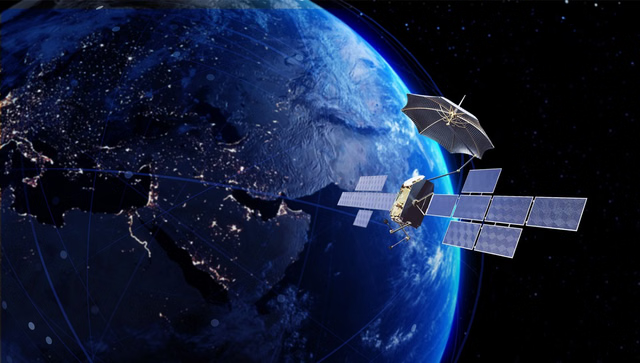
Morocco’s accession signals growing interest among African and Middle Eastern countries in expanding their role within the global space economy, which increasingly spans satellite communications, Earth observation, space research, and emerging commercial space technologies.
The move also reflects Morocco’s broader ambitions to strengthen its scientific and technological positioning while participating more actively in advanced innovation ecosystems. Space-related capabilities are becoming strategically important not only for exploration but also for telecommunications, climate monitoring, agriculture, security, and digital infrastructure.
By joining the accords, Morocco gains greater visibility within international space cooperation frameworks and positions itself closer to future collaborative initiatives tied to research, technology transfer, and aerospace development.
The development highlights how space policy is becoming increasingly interconnected with national digital, industrial, and innovation strategies worldwide.
Editor’s Note
This is not just a diplomatic signing. It reflects the expansion of strategic positioning into the global space economy.
The real story is participation in future infrastructure ecosystems. Space capabilities increasingly influence telecommunications, climate systems, navigation, and national technological competitiveness.
The opportunity is scientific and industrial collaboration. Joining international frameworks can improve access to partnerships, expertise, and future aerospace initiatives.
The advantage is early positioning within Africa. Morocco becomes the first North African participant in a globally significant space governance framework.
The challenge is capability depth. Space participation requires sustained investment in research, talent, and technical infrastructure.
The risk is symbolic engagement without industrial follow-through. Long-term value depends on building actual aerospace and space-tech capabilities domestically.
What to watch next is ecosystem development. The real signal will be whether Morocco expands investment into satellite technologies, research partnerships, and domestic space innovation programmes.