









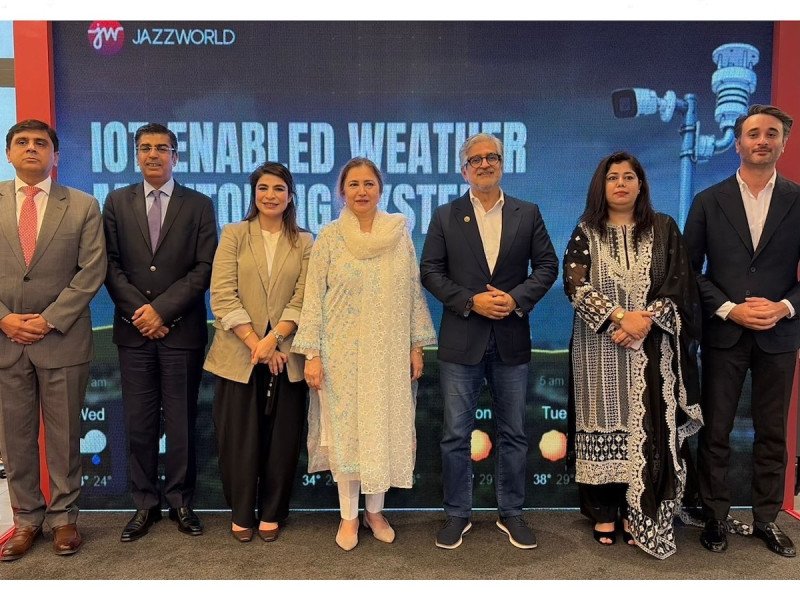
Pakistan’s largest mobile operator Jazz has launched an AI-powered Internet of Things (IoT) weather monitoring station, expanding its role beyond connectivity and into data-driven environmental intelligence, smart infrastructure, and digital innovation.
The initiative combines artificial intelligence, IoT sensors, and real-time data collection to deliver localized weather insights that can support decision-making across sectors including agriculture, disaster management, logistics, infrastructure planning, and public services.
The launch reflects a growing trend among telecommunications operators globally to leverage their network infrastructure, cloud capabilities, and IoT platforms to address real-world challenges beyond traditional communications services. As climate variability increases and extreme weather events become more frequent, access to accurate and timely environmental data is becoming increasingly important for both governments and businesses.
The AI-powered station collects and analyzes weather-related information through connected sensors capable of monitoring environmental conditions in real time. By integrating artificial intelligence into the system, data can be processed more efficiently, enabling enhanced forecasting capabilities and more actionable insights for users.
For Pakistan, the initiative arrives at a critical time. The country remains highly vulnerable to climate-related events including floods, heatwaves, droughts, and changing rainfall patterns. Improving access to localized weather intelligence can help communities, industries, and government agencies better prepare for and respond to environmental risks.
Agriculture stands to be among the sectors that could benefit most from enhanced weather monitoring. Farming remains a major contributor to Pakistan’s economy, and more precise weather data can help farmers make informed decisions regarding irrigation, planting schedules, crop protection, and resource management. Such capabilities are increasingly important as climate conditions become less predictable.
The deployment also demonstrates how telecommunications infrastructure is evolving into a platform for broader digital services. Modern IoT applications rely on reliable connectivity, cloud computing, analytics, and AI capabilities to transform raw data into actionable information. Telecom operators are increasingly leveraging these assets to create solutions for smart cities, industrial monitoring, energy management, transportation, and environmental sustainability.
Across emerging markets, IoT adoption is gaining momentum as governments and enterprises seek ways to improve efficiency, reduce operational risks, and optimize resource utilization. Weather intelligence systems represent one of the most practical applications of connected technologies, particularly in regions where environmental conditions have significant economic and social impacts.
The initiative aligns with Pakistan’s broader digital transformation agenda, which increasingly emphasizes the use of technology to address national development challenges. It also highlights the growing convergence of AI, IoT, and telecommunications infrastructure as organizations seek to create data-driven services capable of delivering measurable societal value.
As demand for real-time data and predictive analytics continues to increase, AI-powered IoT deployments are expected to become an increasingly important component of digital infrastructure ecosystems.
Editor’s Note
Jazz’s weather monitoring initiative illustrates an important evolution in the telecommunications industry. Operators are no longer defined solely by their ability to provide connectivity. They are increasingly becoming providers of intelligence, data platforms, and digital solutions that address sector-specific challenges.
The combination of AI and IoT is particularly significant because it transforms telecommunications networks into systems capable of generating actionable insights rather than simply transmitting information. This shift creates opportunities for operators to participate in sectors such as agriculture, environmental monitoring, public safety, and infrastructure management.
For Pakistan, the development highlights the growing role of technology in climate resilience. Climate adaptation is becoming a strategic priority for many countries, and digital technologies are emerging as critical tools for managing environmental risks. Investments in weather intelligence, predictive analytics, and connected monitoring systems can help improve preparedness while reducing the economic impact of climate-related disruptions.
The initiative also reflects a broader trend across emerging markets where telecom operators are expanding into adjacent digital services to unlock new sources of value. IoT platforms, AI applications, cloud services, and data analytics are becoming important growth areas as traditional connectivity markets mature.
From a digital economy perspective, projects such as this demonstrate how telecommunications infrastructure can support national development objectives beyond communications. The ability to collect, process, and analyze real-time environmental data creates opportunities for more informed decision-making across both public and private sectors.
As AI and IoT technologies continue to converge, the next generation of telecom-enabled services is likely to focus increasingly on delivering intelligence rather than connectivity alone. Jazz’s weather monitoring station offers a glimpse into how operators can leverage digital infrastructure to address complex challenges while contributing to broader economic and societal resilience.