







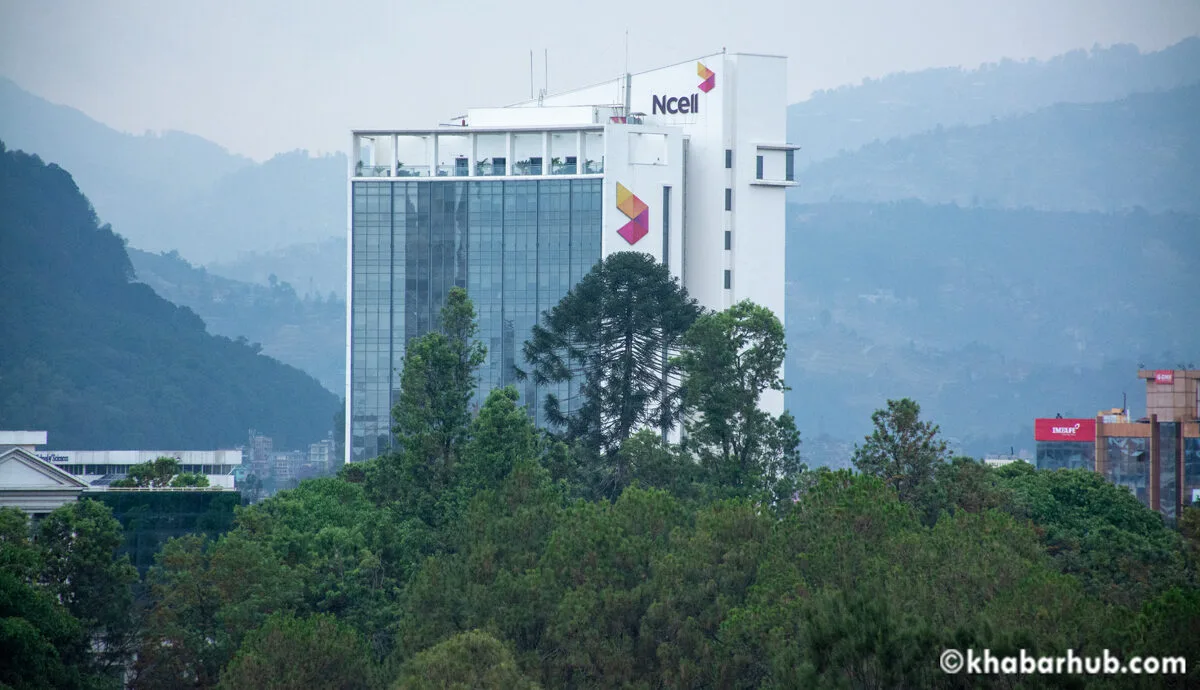
Nepal’s leading private mobile operator Ncell contributed NPR 14.59 billion (approximately $107 million) in taxes, fees and royalties during the first nine months of the 2025/26 fiscal year, underscoring the telecom sector’s importance to public finances even as operators face declining revenues and delays in commercial 5G deployment.
According to company figures, Ncell generated NPR 24.33 billion in revenue during the reporting period, with government payments accounting for 60.81% of total income. Although revenue declined by 1.05% year-on-year, the operator remained one of the country’s largest contributors to the national treasury through license fees, spectrum charges, taxes and regulatory levies.
The figures illustrate the financial pressures facing Nepal’s telecommunications industry as operators continue investing in network infrastructure while awaiting regulatory approval for next-generation mobile services.
Telecom Operators Continue to Support Public Finances
Ncell’s largest payment during the period was the NPR 3.29 billion GSM licence renewal fee, followed by NPR 2.12 billion in telecommunications service fees and NPR 1.96 billion in spectrum fees.
Additional contributions included value-added tax (VAT), royalties, advance income tax, customs duties and payments to the Rural Telecommunications Development Fund.
The scale of these contributions highlights the telecom sector’s role not only as a provider of digital connectivity but also as a significant source of government revenue that supports national development.
Mobile Broadband Adoption Remains Strong
According to the Nepal Telecommunications Authority, Ncell serves 14.03 million mobile subscribers, including 12.21 million mobile broadband users.
The operator also reported 12.12 million 4G subscribers, demonstrating continued demand for high-speed mobile connectivity despite limited progress on commercial 5G deployment.
Strong 4G adoption provides a solid foundation for future network evolution, although operators argue that regulatory certainty is needed before major investments in next-generation infrastructure can proceed.
5G Rollout Continues to Face Regulatory and Investment Challenges
While neighboring countries including India, China, Bangladesh and Afghanistan have already launched or tested 5G services, Nepal’s commercial rollout remains delayed.
Nepal Telecom has received authorization to conduct 5G trials, while Ncell has submitted multiple requests for approval to launch commercial 5G services but is still awaiting regulatory clearance.
Meanwhile, the Ministry of Communication and Information Technology is preparing to auction 5G spectrum by determining reserve prices for the upcoming licensing process.
Industry experts estimate that nationwide 5G deployment could require investments exceeding NPR 40 billion, creating additional financial challenges for operators already experiencing slowing revenue growth.
Balancing Investment with Financial Sustainability
The combination of high regulatory fees, spectrum costs and substantial infrastructure investment requirements is placing increasing pressure on telecom operators.
As demand for mobile data continues to rise, operators must balance continued investment in network modernization with maintaining financial sustainability.
The pace of Nepal’s 5G rollout will likely depend on a combination of spectrum pricing, regulatory policy and operators’ ability to justify large-scale capital investments in a relatively price-sensitive market.
Why This Matters
Telecommunications operators are critical contributors to both digital infrastructure and national revenue. However, sustained investment in next-generation networks requires a regulatory environment that balances government revenue objectives with operators’ ability to finance infrastructure upgrades.
For Ncell, the NPR 14.59 billion contribution highlights its continued economic importance despite softer revenues. For Nepal’s telecommunications sector, the delayed commercialization of 5G illustrates the need for timely spectrum policy, sustainable licensing frameworks and investment incentives to ensure the country’s digital infrastructure keeps pace with regional developments.
Editor’s Note
Nepal’s telecom sector faces a familiar challenge seen across many emerging markets: operators are expected to finance increasingly expensive digital infrastructure while contributing substantial revenues to government budgets. Although mobile broadband adoption remains strong, prolonged uncertainty around 5G licensing and spectrum pricing risks slowing investment in next-generation networks. As neighboring countries expand commercial 5G services, Nepal’s ability to create a balanced regulatory framework that supports both public revenue and private investment will be critical to maintaining digital competitiveness and enabling future AI, cloud and digital economy applications.