




Amazon Web Services will launch its first cloud infrastructure region in Saudi Arabia in December 2026, while an expanded partnership with HUMAIN will make up to 50MW of AI computing capacity available in the Kingdom by 2028.
AWS announced the milestones at LEAP in Riyadh, expanding its cloud and artificial intelligence investment in Saudi Arabia as the Kingdom builds infrastructure to support large-scale AI adoption.
The Saudi cloud region represents more than $5.3 billion in planned infrastructure investment, while the HUMAIN partnership will combine AWS Trainium chips and NVIDIA AI infrastructure to support AI training and inference workloads.
AWS Saudi Arabia region set for December launch
AWS first announced plans for the Saudi Arabia region in March 2024.
Its scheduled December 2026 launch will give developers, startups, enterprises and public-sector organisations access to AWS infrastructure hosted within the Kingdom.
The addition will expand AWS’s global infrastructure footprint to 40 regions worldwide.
Local infrastructure can provide Saudi organisations with greater options for running latency-sensitive workloads and addressing requirements around where applications and data are hosted.
AWS said its regions are designed with sovereignty controls and pointed to its Digital Sovereignty Pledge as the framework governing its approach to cloud sovereignty.
HUMAIN AI Zone to provide up to 50MW by 2028
Alongside the cloud region, AWS has expanded its strategic relationship with Public Investment Fund-owned HUMAIN.
The companies plan to make up to 50MW of capacity available within what they describe as Saudi Arabia’s first AI Zone by 2028.
AWS is HUMAIN’s preferred AI partner under the collaboration.
The infrastructure will include AWS Trainium accelerators as well as the latest NVIDIA AI infrastructure, giving customers access to computing capacity for both AI model training and inference.
The initiative creates a dedicated AI infrastructure layer alongside the more general-purpose cloud capacity being introduced through the Saudi AWS region.
ALLAM Arabic AI model coming to Amazon Bedrock
The partnership also extends into generative AI platforms and models.
HUMAIN’s ALLAM Arabic large language model is expected to become available through Amazon Bedrock, AWS’s managed generative AI service.
This will give Bedrock customers access to Arabic-language AI capabilities through the AWS platform.
The integration could expand the availability of ALLAM to organisations building Arabic applications while allowing developers to access the model alongside other AI models and tools available through Bedrock.
HUMAIN Fabric, the company’s AI-native data infrastructure and a component of the HUMAIN ONE generative AI operating system, will also be made available through AWS Marketplace.
Saudi companies expand AWS cloud and AI adoption
AWS also highlighted a number of Saudi organisations expected to run AI workloads on its infrastructure, including Abdul Latif Jameel, Almosafer, stc Group and Red Bull Mobile.
AWS partners including ZainTECH, Accenture and Tamkeen are also involved in supporting cloud and AI adoption.
stc Group has announced a strategic collaboration with AWS focused on accelerating cloud and AI adoption in Saudi Arabia.
ZainTECH, meanwhile, has entered a multi-year agreement designed to help organisations deploy AWS solutions while strengthening security and compliance readiness.
The ecosystem of telecom operators, technology providers and enterprise customers will be important as AWS seeks to translate infrastructure investment into domestic cloud and AI workloads.
AWS links infrastructure investment with Saudi AI ambitions
Saudi Arabia is rapidly expanding the physical infrastructure required to support its wider AI strategy.
AWS CEO Matt Garman said the new region and HUMAIN partnership would provide full-stack cloud and AI infrastructure to support new industries and Vision 2030.
Saudi Minister of Communications and Information Technology Abdullah Alswaha said the projects would contribute to the computing capacity required for the AI era and strengthen the Kingdom’s position as a global computing partner.
An IDC report commissioned by AWS estimates that AI could contribute $130 billion to Saudi Arabia’s economy by 2030.
The forecast is an estimate rather than a confirmed economic outcome, but it illustrates the scale of expectations surrounding AI investment in the Kingdom.
AWS targets more than 100,000 Saudis with digital training
AWS is coupling its infrastructure expansion with a significant skills development programme.
The Amazon Academy, launched in partnership with Saudi Arabia’s Ministry of Communications and Information Technology, aims to provide free training in cloud computing, AI, logistics and retail to more than 100,000 Saudi citizens.
AWS is also working with 11 higher education institutions in the Kingdom.
Its Saudi Arabia Women’s Skills Initiative is targeting free training for up to 10,000 women.
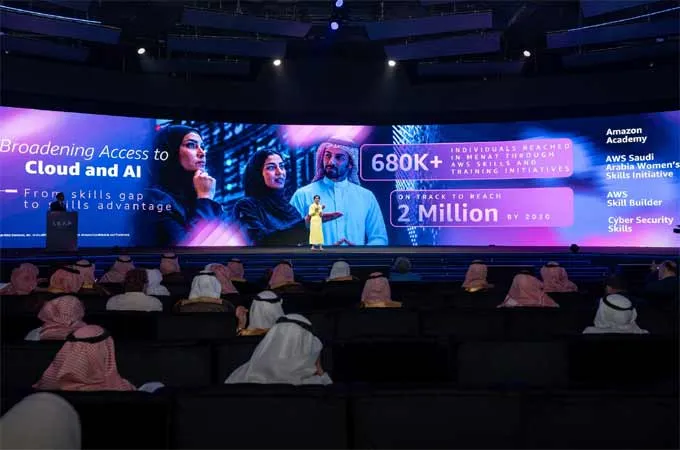
Across the Middle East, North Africa and Turkey, AWS has committed to reaching two million people with AI and cloud training by 2030. The company said more than 680,000 individuals have participated to date.
AWS also plans to establish two innovation centres in Saudi Arabia to provide startups and entrepreneurs with technical mentorship and training.
Why this matters
The combination of a $5.3 billion cloud region and up to 50MW of dedicated AI capacity gives AWS a substantially larger physical presence in Saudi Arabia’s rapidly expanding digital infrastructure market.
The two investments also serve different requirements. The Saudi AWS region will provide a local foundation for general cloud applications and enterprise workloads, while the HUMAIN AI Zone is being designed around the much more compute-intensive requirements of AI training and inference.
The ALLAM integration adds another dimension. Saudi Arabia is not only seeking infrastructure on which AI can run, but also attempting to build models and platforms that can be distributed through major global cloud ecosystems.
Editor’s note
December 2026 will be an important milestone because the AWS Saudi region is moving from a previously announced investment plan towards a defined launch.
The 50MW HUMAIN AI Zone should be viewed separately. That capacity is targeted for availability by 2028 and should not yet be treated as operational infrastructure.
Together, however, the projects illustrate how Saudi Arabia’s AI strategy is developing across multiple layers: hyperscale cloud, accelerated computing, local AI models, data platforms and workforce development. The key measures to watch will be how quickly the infrastructure reaches operational capacity, how much of it is consumed by Saudi workloads and whether locally developed platforms such as ALLAM gain meaningful adoption through global distribution channels such as Amazon Bedrock.