





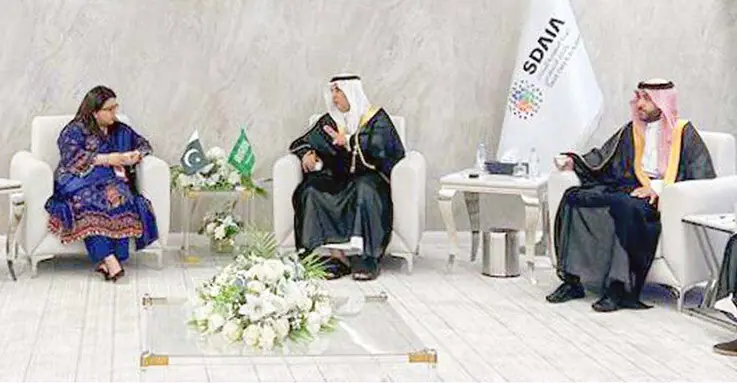
Pakistan is developing a national digital stack as part of a broader effort to accelerate digital transformation, strengthen public digital infrastructure and create a foundation for private-sector innovation, Federal Minister for Information Technology and Telecommunication Shaza Fatima Khawaja said at LEAP 2026 in Riyadh.
Speaking during a session titled “How We Built a Digital Nation,” Khawaja positioned the initiative alongside investments in connectivity, technology zones and institutional reforms intended to strengthen Pakistan’s digital economy and attract international investment.
The minister also inaugurated the Tech Destination Pakistan Pavilion at LEAP 2026, featuring 25 startups and 50 Pakistani technology companies showcasing solutions spanning artificial intelligence, automation and other digital technologies.
National digital stack takes shape
Khawaja said Pakistan is developing a national digital stack that will provide core digital infrastructure upon which government services and private-sector applications can be built.
The initiative forms part of Pakistan’s wider digital transformation programme, which the government has sought to institutionalise through legislation.
The Digital Nation Pakistan Act established the National Digital Commission and Pakistan Digital Authority, creating dedicated institutional structures responsible for advancing the country’s digital transformation agenda.
Khawaja argued that establishing a central digital agency is important for translating national policy into implementation, while measurable key performance indicators can help maintain accountability across large-scale transformation programmes.
Government positions infrastructure as foundation for private innovation
The minister said the government’s role should focus on developing core digital infrastructure and creating an environment in which private companies can build services and drive economic growth.
Pakistan’s approach has included investments in telecommunications connectivity, spectrum, special technology zones and measures intended to improve the competitiveness of the domestic IT industry.
Khawaja cited the country’s recent 5G spectrum auction as part of that infrastructure push, alongside reduced taxation for the IT sector.
The broader strategy is designed to combine digital public infrastructure with private-sector investment rather than positioning government as the sole provider of digital services.
Pakistan pitches technology sector at LEAP 2026
Pakistan is also using LEAP 2026 to increase international exposure for its technology industry.
The Tech Destination Pakistan Pavilion includes 25 startups and 50 established technology companies presenting products and capabilities to investors, technology companies and potential international partners.
Participating companies are showcasing solutions across AI, automation and digital technologies.
Pakistan’s presence at the Riyadh event is intended to facilitate business-to-business partnerships, attract international investment, expand market access and create additional opportunities for technology exports.
The pavilion also gives Pakistani startups and technology companies direct exposure to the international technology and investment ecosystem gathering in Saudi Arabia for LEAP.
Saudi Arabia identified as key digital partner
Khawaja also called for deeper technology cooperation between Pakistan and Saudi Arabia.
Potential areas highlighted include digital innovation, capacity building and emerging technologies.
Saudi Arabia has become an increasingly important technology market as investment expands across AI, cloud computing, data centres, digital government and other areas of digital infrastructure.
For Pakistan, closer engagement could create opportunities for its technology companies and skilled workforce while also supporting investment into the domestic digital economy.
Digital policy moves towards implementation
Pakistan’s digital transformation agenda increasingly combines regulatory reform with physical and institutional infrastructure.
The Digital Nation Pakistan Act provides the legislative foundation, while the National Digital Commission and Pakistan Digital Authority create mechanisms for coordinating execution.
Connectivity investments and spectrum availability provide another layer, while technology zones and IT-sector incentives are intended to stimulate private investment and technology exports.
The development of a national digital stack could become another important component by providing reusable digital infrastructure that government agencies and private companies can build upon.
However, the source does not provide technical details about the stack’s architecture, individual components, implementation timetable or current deployment status.
Why this matters
National digital stacks can reduce fragmentation by providing common infrastructure that multiple government services and private applications can use rather than requiring individual organisations to build foundational systems independently.
For Pakistan, the strategic opportunity is to connect this infrastructure with its broader digital economy ambitions, including technology exports, startup development, digital government and international investment.
The combination of institutional reform, connectivity investment and a national digital stack could provide a stronger foundation for digital services. Its impact, however, will depend on interoperability, adoption across government, security, data governance and the ability of private companies to build effectively on top of the infrastructure.
Editor’s note
Pakistan appears to be moving from a collection of individual digital initiatives towards an attempt to build a more coordinated national technology architecture.
The national digital stack could become one of the most consequential parts of that strategy, but the details will matter. Its value will ultimately depend on what common digital capabilities it provides, how government agencies integrate with them and whether developers and businesses can use the infrastructure to create new services.
LEAP also gives Pakistan an important commercial platform. With 25 startups and 50 technology companies represented in Riyadh, the stronger measure of success will be what follows the exhibition: investment commitments, Saudi-Pakistani technology partnerships, export contracts and sustained market access for Pakistani companies.