

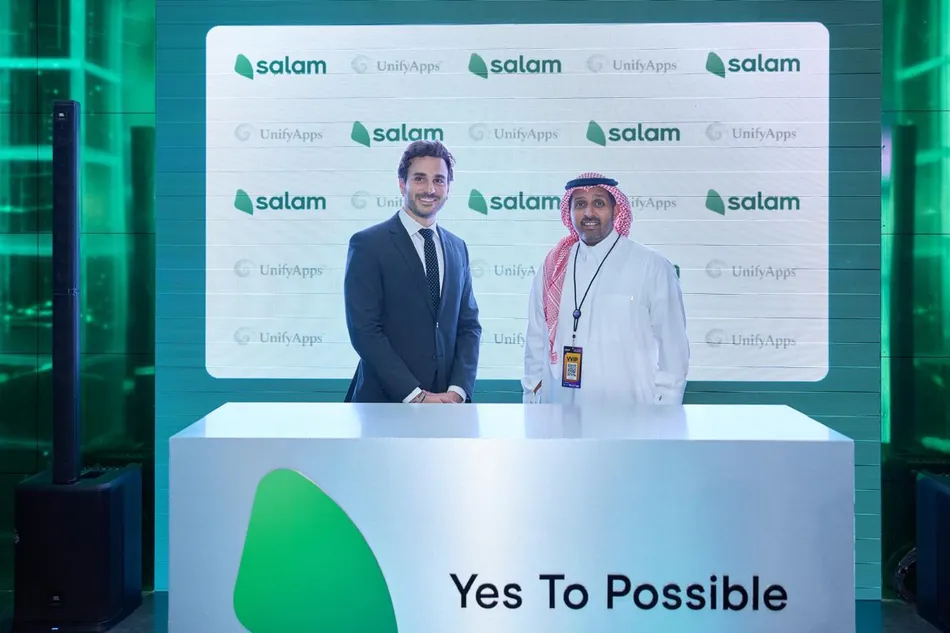
Saudi Arabia’s Etihad Salam Telecom Company has signed a Memorandum of Understanding with UnifyApps to explore the delivery of agentic AI automation solutions to government entities and enterprises across the Kingdom, targeting workflow automation, operational efficiency and wider AI adoption.
The agreement was announced at LEAP 2026 in Riyadh, where Salam is participating as a strategic sponsor.
The collaboration combines Salam’s local telecommunications, cloud and digital infrastructure capabilities with UnifyApps’ Agentic Automation platform, with the companies aiming to provide Saudi organisations with a locally supported route for introducing AI agents into business processes.
Partnership targets complex enterprise workflows
Under the MoU, Salam and UnifyApps intend to help government and enterprise customers automate workflows using AI agents.
The companies said the technology could be used to streamline processes and reduce operational costs by allowing AI-powered systems to handle increasingly complex workflows.
Unlike conventional automation, which typically follows predefined rules and sequences, agentic AI systems are designed to perform tasks with greater autonomy, coordinating actions and information across different applications and business processes.
The agreement does not identify specific customer deployments, use cases or implementation timelines.
Salam to provide local commercial and delivery layer
A key element of the proposed partnership is Salam’s role as the local interface for customers adopting UnifyApps technology.
Salam is expected to act as a single point of contact across sales, support and delivery while helping customers navigate Saudi Arabia’s regulatory, infrastructure and operational requirements.
The companies said this model is intended to reduce adoption risk by combining UnifyApps’ automation platform with local technical expertise and accountability.
For UnifyApps, the relationship also provides a route into Saudi government and enterprise customers through an established domestic telecommunications and ICT provider.
Salam expands beyond traditional connectivity
The agreement fits within Salam’s broader evolution from a telecommunications provider toward a wider digital transformation role.
The company provides fixed and mobile telecommunications alongside cloud computing, data centre and digital infrastructure services for enterprises, government entities and carriers.
Adding agentic automation capabilities could allow Salam to move further into enterprise applications and AI-enabled business transformation, extending its role beyond providing the underlying connectivity and infrastructure.
Salam Chief Business Officer Abdullah Khorami said the collaboration supports the company’s ambition to become a strategic digital transformation partner.
“Our partnership with UnifyApps is aligned with our commitment to powering what’s next for Saudi Arabia’s digital future and enable government and enterprise organizations to embrace AI-driven transformation with confidence,” Khorami said.
UnifyApps targets Saudi government and enterprise market
UnifyApps will contribute its Agentic Automation platform and related technology expertise.
Regional Director Amr Abou Reslan said the partnership would focus on helping Saudi organisations use AI agents to automate complex workflows and improve operational efficiency.
The collaboration comes as Saudi Arabia continues to expand investment and adoption across artificial intelligence, cloud infrastructure and enterprise digitalisation as part of its wider economic transformation agenda.
Government entities and large enterprises represent an important market for these technologies, particularly where organisations are attempting to integrate AI into existing systems rather than deploy isolated generative AI applications.
MoU remains an exploratory framework
While the agreement establishes a framework for cooperation, Salam and UnifyApps have not announced specific commercial contracts or confirmed deployments resulting from the partnership.
No financial terms, customer commitments or implementation targets were disclosed.
The next stage will therefore depend on whether the companies convert the MoU into customer projects and demonstrate how agentic automation can operate within Saudi enterprise and government technology environments.
Why this matters
Agentic AI is emerging as the next phase of enterprise AI adoption, with organisations increasingly looking beyond conversational assistants toward systems capable of executing multi-step business processes.
For Saudi organisations, however, deploying these systems at scale also introduces questions around integration, governance, security, data management and regulatory compliance.
The Salam-UnifyApps model attempts to address part of that challenge by pairing an international automation platform with a Saudi technology provider capable of supporting local infrastructure, delivery and operational requirements.
Editor’s note
The strategically interesting part of this MoU is Salam’s continued movement up the enterprise technology stack.
Telecom operators increasingly have an opportunity to combine connectivity, cloud and data centre infrastructure with AI applications and managed digital services. Agentic automation potentially gives Salam another layer through which it can deepen relationships with large enterprise and government customers.
For now, however, this remains an MoU rather than a confirmed deployment programme. The key indicators to watch will be named customer implementations, the workflows selected for automation, measurable cost or productivity improvements, and how the companies address governance and security as AI agents gain greater autonomy inside critical enterprise processes.