







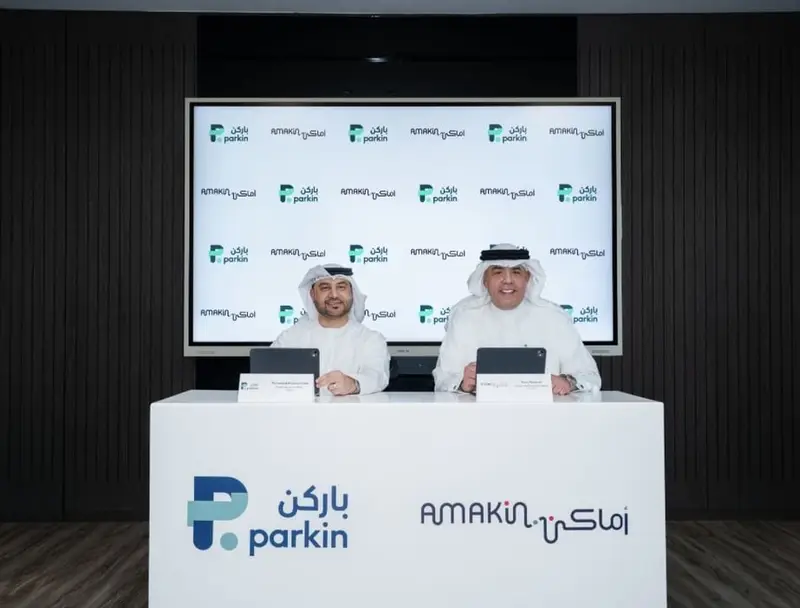
Dubai-based Parkin Company has signed a memorandum of understanding with Bahrain Car Parks Company, Amakin, to explore cooperation across parking technology, digital payments, mobility data and regional business development.
The agreement creates a framework for the two companies to combine their digital platforms, operational capabilities and market expertise to improve parking services in the UAE and Bahrain and potentially expand into other GCC and international markets.
Platform integration could create more seamless parking access
One of the main areas under evaluation is integration between Parkin and Amakin’s digital platforms.
The companies will assess how their systems can be connected to streamline operations and create a more consistent customer experience across both markets.
That could reduce friction for users who rely on different apps and payment systems when moving between Dubai and Bahrain.
Cross-market parking payments under consideration
The MoU also covers the feasibility of enabling customers to access and pay for parking across both networks through the companies’ existing mobile applications.
If implemented, this could create a more connected UAE-Bahrain parking experience and reduce the need for users to manage separate payment processes.
The source does not confirm that cross-platform payments are live, only that the companies will evaluate the opportunity.
Mobility data to support smarter parking decisions
Parkin and Amakin also plan to explore the use of mobility data to identify usage patterns and support new data-driven parking solutions.
This could help improve areas such as demand forecasting, space availability, traffic flow and operational planning.
For parking operators, better use of data can improve both customer experience and asset utilisation.
Parkin looks beyond Dubai
Mohamed Abdulla Al Ali, chief executive officer of Parkin, said the collaboration represents a step toward extending the company’s smart parking capabilities beyond Dubai.
He said the partnership brings together complementary technologies and digital platforms while creating opportunities for future growth across the GCC and beyond.
The agreement therefore has both operational and strategic value for Parkin as it explores expansion outside its home market.
Amakin targets convenience and better space visibility
Tariq Ali Aljowder, chief executive officer of Amakin, said the partnership is focused on making parking simpler and more convenient for customers.
He highlighted faster payments and more accurate information on space availability as areas where technology collaboration could improve the user experience.
Amakin also brings local market knowledge in Bahrain, which could help shape how integrated solutions are adapted to customer needs.
Regional business development forms part of the MoU
Beyond technology integration, the agreement gives Parkin and Amakin a framework to explore joint business opportunities across the GCC and selected international markets.
This opens the possibility of collaboration on future parking, mobility and smart-city projects beyond the UAE and Bahrain.
Why this matters
The agreement reflects a broader shift in parking from a physical infrastructure service toward a digitally managed mobility platform.
Apps, payments, data analytics and real-time availability are increasingly becoming central to how parking networks are operated and monetised.
For Parkin and Amakin, integrating parts of their digital ecosystems could create a more scalable model for regional expansion while improving convenience for users.
Editor’s note
The most interesting aspect of the MoU is the potential move toward interoperable parking services across borders.
If users can eventually access and pay for parking through familiar apps across multiple GCC markets, parking could begin to resemble other regional digital mobility services rather than remain fragmented by city or operator.
The next step will be whether the companies move from evaluation into actual platform integration, cross-market payments and joint deployments.