








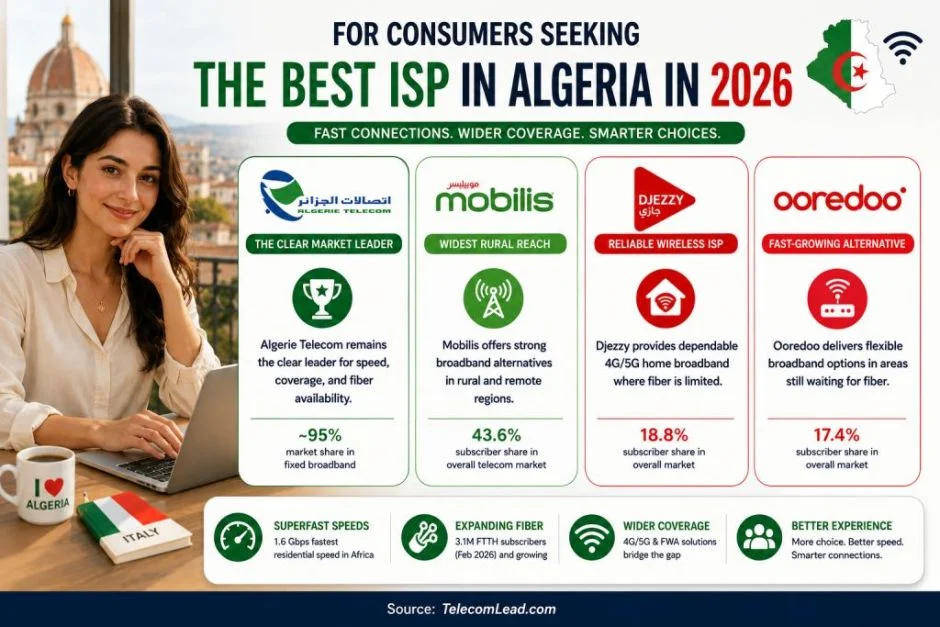
Algeria is rapidly advancing its fiber-to-the-home (FTTH) deployment strategy, positioning itself as a leading contender to become Africa’s first “Gigabit Society” as nationwide broadband investments continue to transform the country’s digital infrastructure landscape.
The expansion is being driven primarily by state-owned operator Algeria Telecom, which has significantly accelerated fiber rollouts across urban and suburban areas, enabling more households and businesses to access ultra-high-speed internet services.
According to industry reports, Algeria has emerged as one of Africa’s strongest broadband performers, with growing fiber penetration helping to improve internet speeds, service quality, and digital accessibility. The country’s ambitious connectivity strategy reflects a broader national effort to strengthen digital infrastructure as a foundation for economic modernization and digital transformation.
Fiber connectivity is increasingly viewed as critical infrastructure, supporting everything from cloud services and e-government platforms to online education, remote work, digital commerce, and emerging technologies such as artificial intelligence. By expanding FTTH coverage, Algeria aims to create the high-capacity networks required to support future digital growth.
The rollout comes amid rising demand for bandwidth-intensive applications and digital services. Consumers and businesses are increasingly relying on high-speed connectivity for video streaming, cloud computing, collaboration platforms, gaming, and data-intensive enterprise operations.
Algeria Telecom has made fiber deployment a strategic priority in recent years, investing heavily in broadband infrastructure upgrades and replacing legacy connectivity technologies with next-generation fiber networks. These efforts have contributed to improved network performance and expanded access to gigabit-capable services.
The country’s digital transformation agenda extends beyond connectivity, encompassing e-government initiatives, digital entrepreneurship, financial technology adoption, and broader efforts to develop a competitive digital economy. Reliable, high-speed broadband is considered a foundational requirement for achieving these objectives.
Across Africa, governments and operators are intensifying investments in fiber infrastructure as they seek to bridge digital divides and support long-term economic development. While mobile broadband remains the dominant connectivity platform in many markets, fiber networks are increasingly recognized as essential for supporting advanced digital services and future technology adoption.
As deployment continues, Algeria’s expanding fiber footprint is expected to play a central role in strengthening digital inclusion, improving service quality, and enabling greater participation in the digital economy.
Editor’s Note
Algeria’s FTTH expansion represents one of the most significant broadband infrastructure stories in Africa today. While much of the continent’s connectivity growth has been driven by mobile networks, gigabit societies are ultimately built on fiber. The strategic importance of Algeria’s rollout lies not only in faster internet speeds but in the creation of a long-term digital foundation capable of supporting AI, cloud services, digital government, smart industries, and future innovation ecosystems. If Algeria can sustain deployment momentum and expand adoption, it could emerge as a benchmark for broadband-led digital transformation across Africa, demonstrating how large-scale fiber investment can accelerate economic competitiveness and digital inclusion simultaneously.